Rock Tumbling for Beginners: How to Tumble Rocks Step by Step
A beginner's guide to rock tumbling: what you need, choosing rocks, the four grit stages, cleaning between stages and how long it takes to get shiny stones.
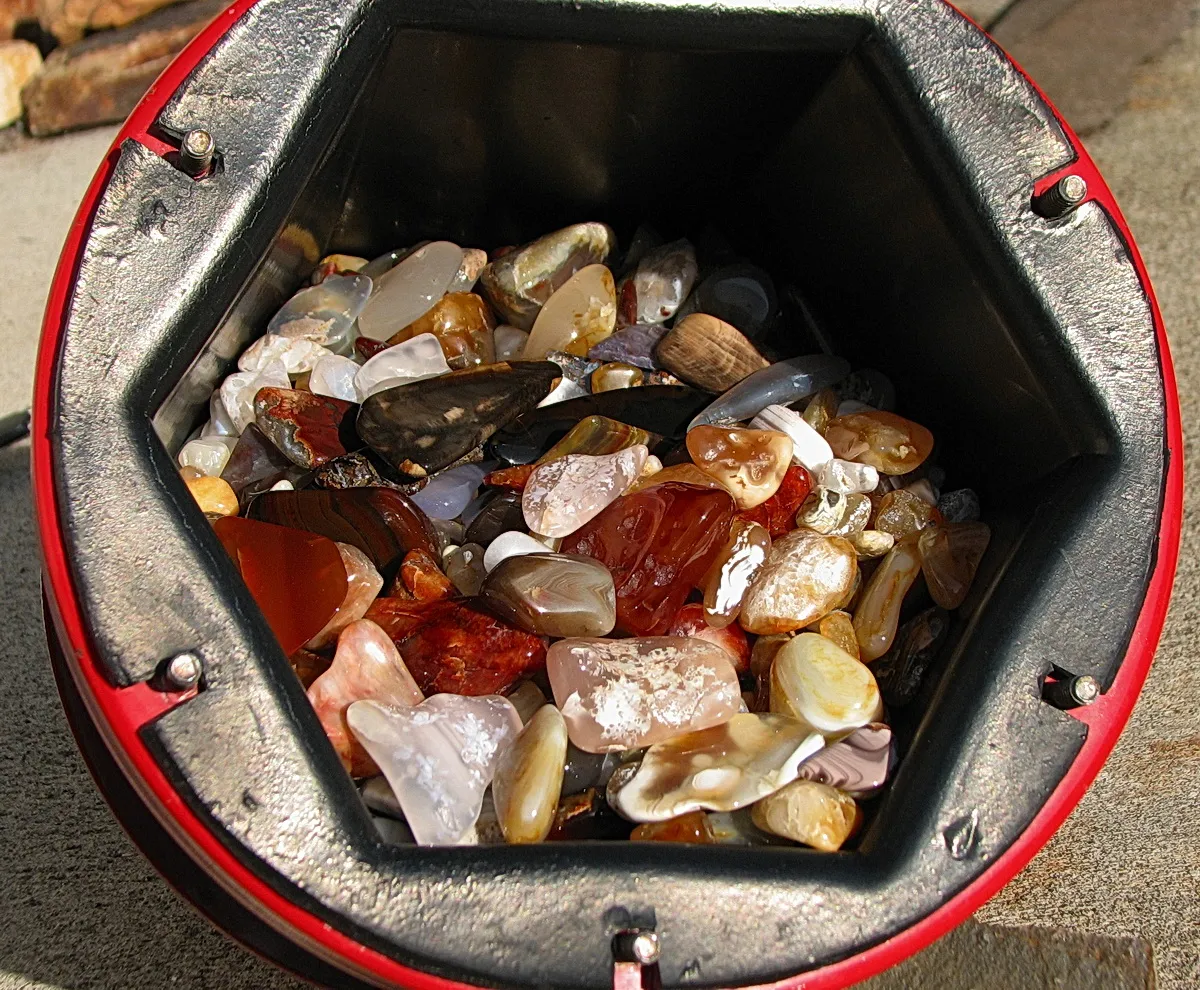 Photo: 88pathoffroad, CC BY-SA 3.0
In this guide
Short answer: load a rotary tumbler about half to two-thirds full with rocks of similar hardness, add about 2 level tablespoons of coarse grit per pound of rock and water to just below the top of the rocks, and let it run. Repeat with medium, fine and polish stages, cleaning everything between stages. With about a week per stage, a full run takes roughly 4–6 weeks, longer if the rough is very angular.
What you need
- A rotary tumbler with a rubber barrel (3 lb is a common beginner size)
- Rough rock: agate, jasper and quartz are the classic beginner choices
- A grit kit: coarse, medium and fine silicon carbide grit, plus a polish
- Ceramic media (optional) to fill up the barrel and cushion the stones
- A bucket and a colander for cleaning between stages
Silicon carbide grit is very hard, about 9 to 9.5 on the Mohs scale, so it grinds down stones that are around 7, like agate and jasper.
Step 1: Choose your rocks
Tumble rocks of similar hardness together. Softer stones wear away much faster and can get chipped or scratched by harder ones. For beginners, stick to chalcedony and quartz: agate, jasper, carnelian, petrified wood, amethyst, rose quartz, tiger’s-eye. See the best rocks to tumble.
Mix sizes between about 1/4 in and 1 1/2 in (0.5–4 cm) so small stones work into the gaps between large ones.
Step 2: Load the barrel
- Fill the barrel about half to two-thirds full with rock. Top up with ceramic media if needed.
- Add about 2 level tablespoons of grit per pound of rock.
- Add water until it’s just below the top of the rocks.
- Close the lid tightly and check for leaks.
More detail in how to load a rock tumbler. Our Tumbling Planner calculates the grit for your barrel size.
Step 3: Run the four stages
| Stage | Grit | Typical time (rotary) | What it does |
|---|---|---|---|
| 1. Coarse | 60/90 silicon carbide | 1 week, often 2–3 for angular rough | Rounds the shape, removes pits and cracks |
| 2. Medium | 120/220 or 150/220 silicon carbide | 1 week | Removes scratches from the coarse grit |
| 3. Fine | 500/600 silicon carbide | 1 week | Leaves a smooth, matte surface |
| 4. Polish | Aluminum oxide or cerium oxide | 1 week | Brings out the shine |
Read the full grit schedule for when to extend each stage.
Step 4: Clean between every stage
This is where most beginners go wrong. A few grains of coarse grit carried into the polish stage leave scratches on every stone.
- Pour the barrel into a colander over a bucket, and rinse rocks thoroughly.
- Scrub the barrel and lid.
- Check rocks for cracks and pits. Rocks that still have them go back in the coarse stage.
Step 5: Burnish (optional)
If stones look slightly hazy after polishing, tumble them for an hour or a few hours in water with a little soap. This cleans off polish residue and often improves the shine.
How long does rock tumbling take?
| Rough | Total time |
|---|---|
| Smooth beach pebbles | About 4 weeks |
| Average rough | About 4–6 weeks |
| Very angular or pitted rough | 6–8 weeks or more |
Vibratory tumblers work faster and keep the shape of the stone, but they don’t round rocks the way a rotary tumbler does.
Frequently asked questions
How long should I tumble rocks in each stage?
About a week per stage in a rotary tumbler. The coarse stage often needs 2–3 weeks for angular rough. Don’t move on until the shapes look right.
Can I reuse tumbling grit?
Not really. Grit breaks down as it tumbles and loses its cutting power. Use fresh grit for each stage.
Why aren’t my rocks shiny?
Usually because of a rushed coarse stage, contamination between stages or soft stones. See why aren’t my tumbled rocks shiny.
Is rock tumbling loud?
Rotary tumblers make a steady rumbling noise. Many people run them in a garage, basement or closet.